Why would someone rather sit on a rock than a bench? We found five particularly good spots in Tampere
Why do we gravitate towards certain spots to sit on in public spaces? We asked a professor and tried out spots in Tampere. One bench rose above the others.
Original text and pictures: Aukusti Palosaari
Translation: Henna Herronen
There are benches in the city that no one sits on.
The situation becomes slightly awkward for the bench if, a few metres away, someone is sitting on a rock, a wall, or stairs.
I started noticing such spots after seeing the Youtube video The Reason You Never Sit in the Middle by Paul Stout. The video poses a simple question: why do people so often gravitate towards the edges in public spaces?
Stout traces the idea back to human evolution. From a sheltered place, you could observe your surroundings while being safe from anything sneaking up behind you.
In Tampere, the greatest threat to one’s back is usually not a predator but an electric scooter.
Could a good place to sit be one where you can be present but not right in the middle of everything?
A mere view does not make the place
According to Panu Lehtovuori, Professor of Urban Studies at the Estonian Academy of Arts, the importance of prospect and refuge is a familiar concept in environmental psychology. As a researcher of public urban space, Lehtovuori also pays attention to what happens in a place and how people use it.
Lehtovuori mentions the Danish architect Jan Gehl, who has popularised a way of looking at public spaces that emphasises human activity.
In urban space, both activities that we have to do and activities that we do voluntarily take place.
Having to get groceries. Having to walk to the bus stop. Having to get to school.
In the same space, someone is sitting on a terrace, meeting their friends, or otherwise just spending time there.
According to Lehtovuori, a functioning public space is at its best created by a mixture of these.
“Other people, what they do, and the social opportunities are quite essential for the functionality,” Lehtovuori says.
Lehtovuori brings up Hämeenkatu as an example. According to Lehtovuori, many of the defining elements of Tampere are located along it: the railway station, the Central Square, the Tammerkoski rapids, the historic industrial milieu, and the view towards Pyynikki. In Lehtovuori’s opinion, it is precisely the combination of different activities, places, and views that makes Hämeenkatu particularly successful.
Lehtovuori is also interested in the edges of urban space. In their own research, Lehtovuori has examined, for example, events and the types of spots that tend to generate activity.
“There is something about edges that makes them the places where the most activity seems to happen.”
An edge can be a wall or a step, but it can as well be a spot where the park turns into a street, an interior space into an exterior space, or one route into another.
Enough of theory.
It is time to sit.
Hiedanranta rocky viewpoint – the best way to get there is by getting lost
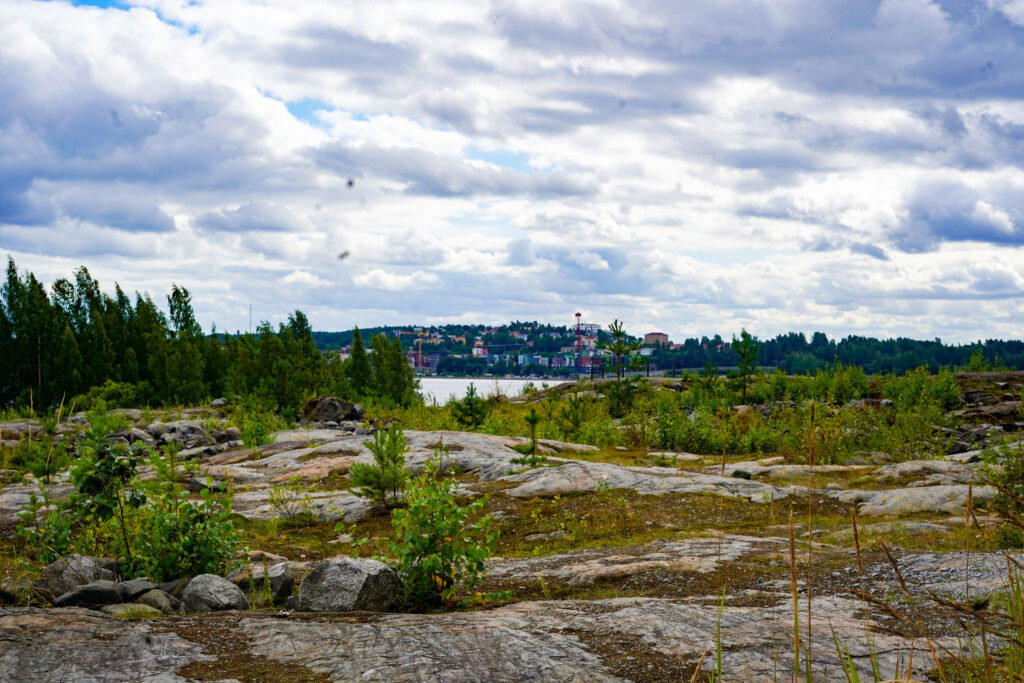
The first spot is not a bench.
It is a viewpoint on top of exposed bedrock in Hiedanranta.
The easiest way to get there is by getting lost. A smaller path branches off from the jogging track; walk along it for a moment and voilà: a dream spot for an observer opens up before you.
The viewpoint overlooks Lentävänniemi, Pispala, and the city centre. You can watch the joggers passing below from a safe distance. Behind you there is a forest.
The smooth bedrock is surprisingly comfortable to sit on: dry, fairly flat, and almost free of loose stones.
Still, after sitting there for a while, you start to appreciate a camping chair.
Next to Vapriikki – luxury just a few metres away
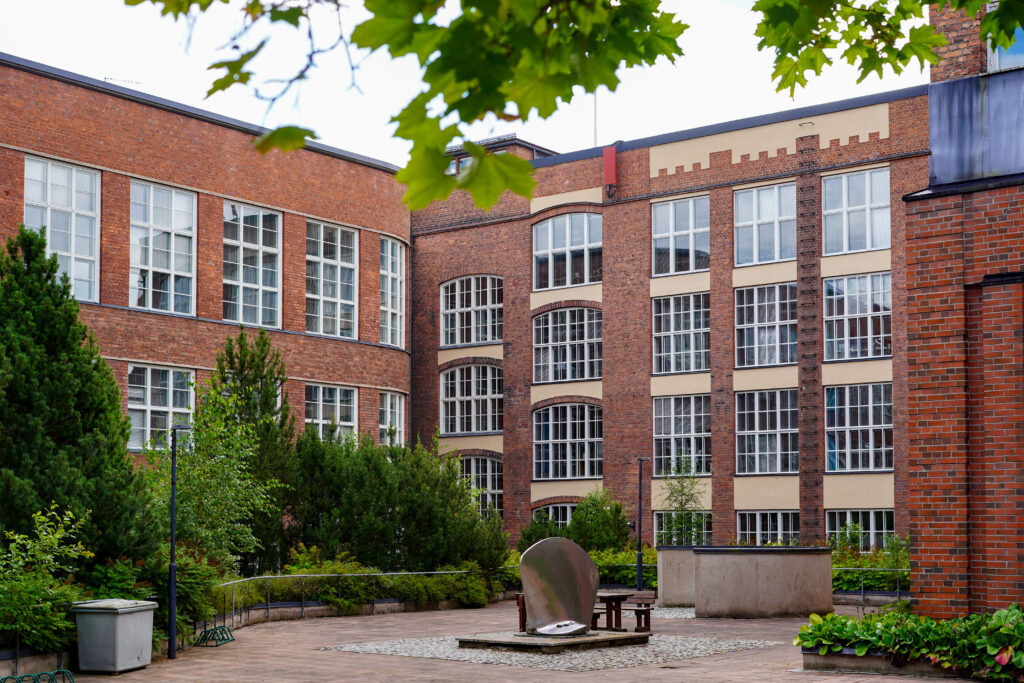
There is a picnic table in the vicinity of the main entrance to the Vapriikki Museum Centre, and, at first, taking a seat at the table feels a little like accidentally trespassing on a private yard.
An orange brick wall borders the space and protects your back. From the table, you can still observe people arriving at and leaving the museum.
The sound of traffic provides just the right amount of background noise. The city is close enough to be heard, but the sound does not make the place feel restless.
Lehtovuori considers the human scale to be one of the characteristics of a good public space. The space should allow you to be near other people and to observe them. Smallness and a certain kind of intimacy can, according to Lehtovuori, make a place pleasant.
There, in the corner of Vapriikki, the idea is easy to take in. Passers-by are close, but the picnic table feels like a small space of its own.
Then there are the benches.
Their boards curve to follow the shape of your buttocks. In the world of city benches, this feels almost like a luxury.
Näyttämönpuisto – Hervanta disappears from view
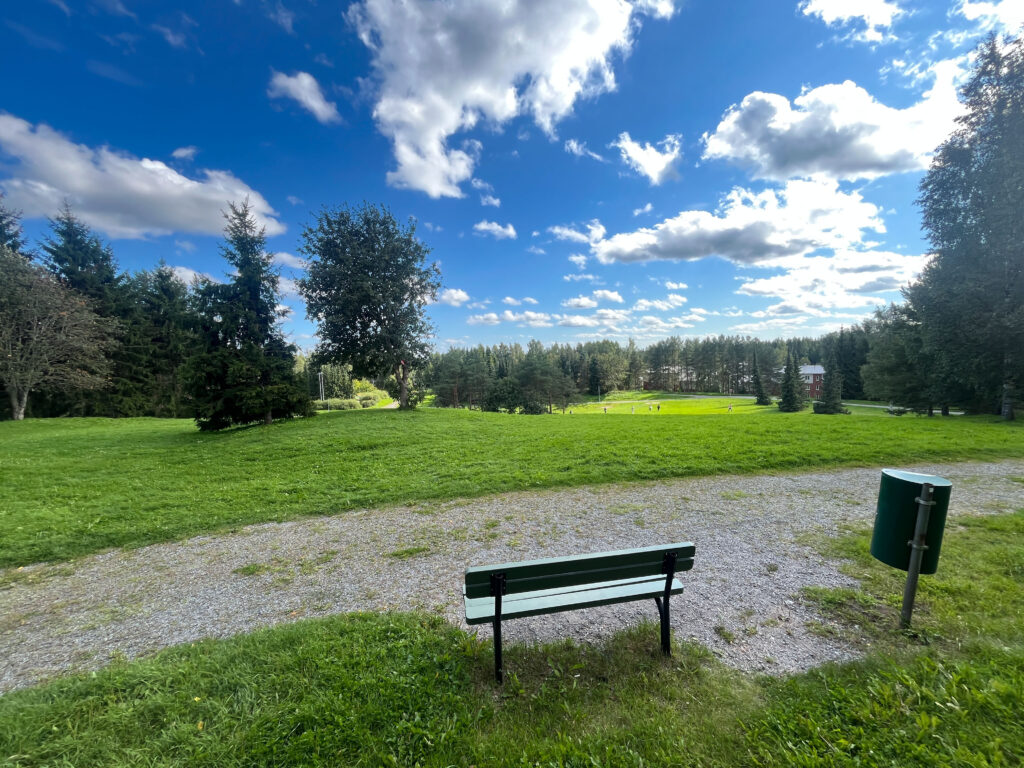
In Hervanta, it is hard to avoid concrete.
In the Näyttämönpuisto park, it is possible.
In the middle of a disc golf course, on top of a mound, there is a bench from which a lush green park scenery opens up. Buildings remain hidden behind the trees and mounds, and while sitting on the bench, you can see Hervanta disappearing right before your eyes.
Even so, the bench does not provide perfect peace and quiet. Behind it stands a disc golf basket.
Koskipuisto – there is always someone there
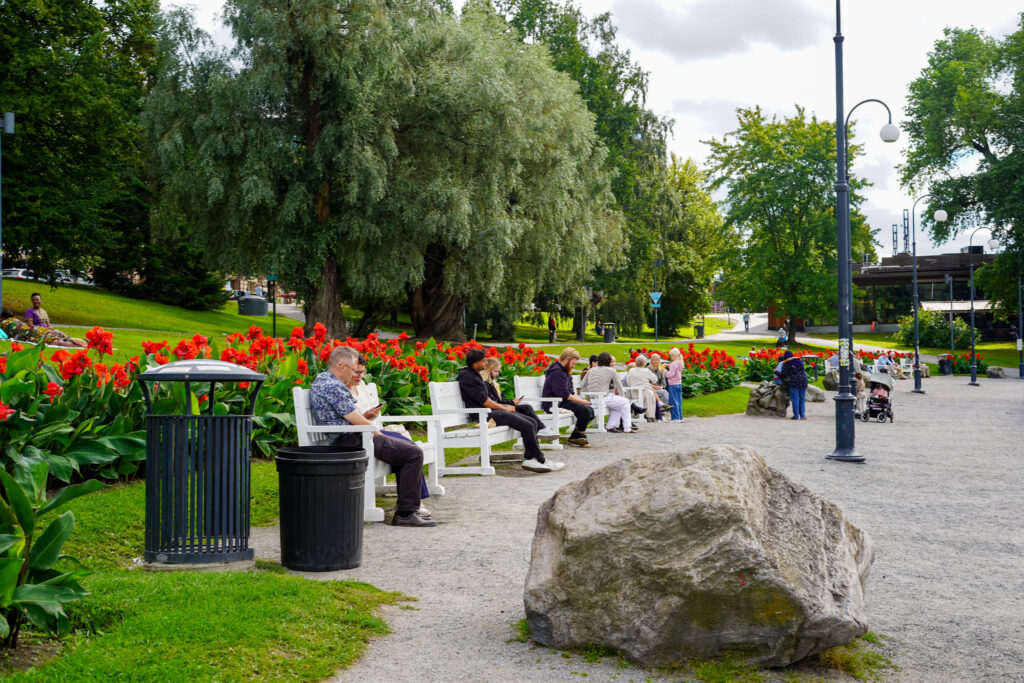
When asked about good public spaces in Tampere, the Koskipuisto park quickly springs to Lehtovuori’s mind.
There is nothing especially remarkable about the park itself, says Lehtovuori. The location is another matter.
The park is located just off Hämeenkatu, and it lies at the junction of the routes that run along the Tammerkoski rapids. The place is easy to get to and easy to continue from.
Lehtovuori also highlights the railing by the rapids. That is where the park ends and the rapids begin, but, at the same time, the edge offers a spot to lean on and watch the flowing water and the surrounding city.
Urban design researcher Quentin Stevens uses the term props for these kinds of urban structures: they offer people possibilities to use space for more than passing through.
And there is practically always someone there.
Someone is always passing through the park. Someone stays.
It is close to what Lehtovuori means when speaking about the mixing of Gehl’s necessary and optional activities.
One looking for a seat has many options. You can spread out on the lawn; further up are the traditional benches, and closer to the banks are white benches beside flower beds.
Lehtovuori also brings up the light. In Finland, Lehtovuori says, the aim in planning is to make the sunniest spots available for people to use whenever possible. Koskipuisto opens towards the west, receiving sunlight for most of the day.
With global warming, Lehtovuori says, the question is changing: sunlight will still be important, but so will adequate shade.
Pyykkimettä – the best saved for last
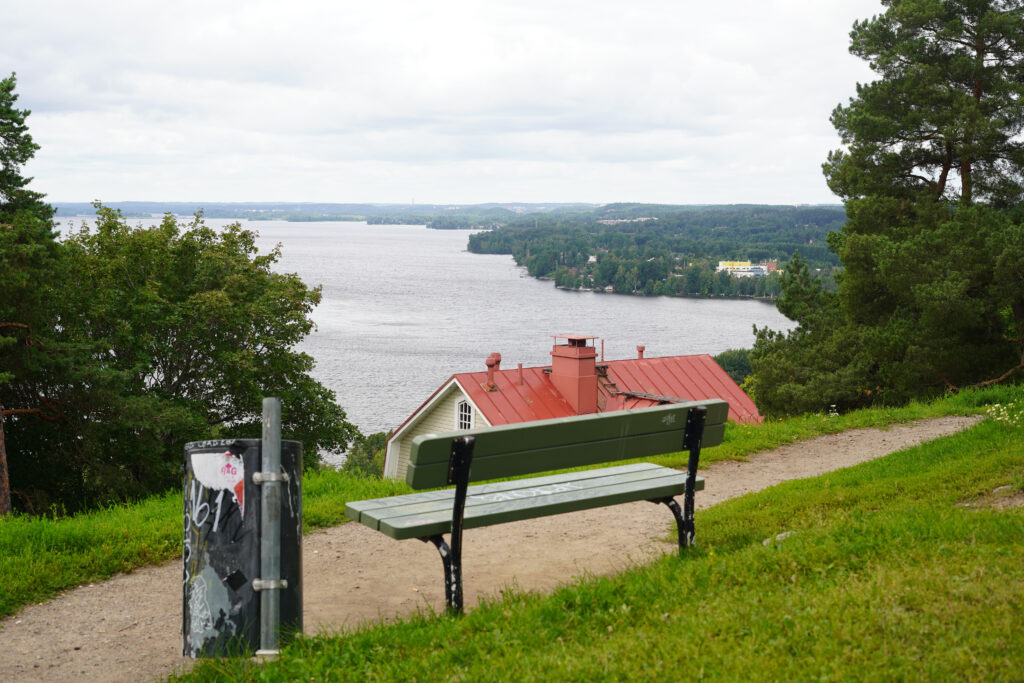
Pyykkimettä park, located on top of the Pispalanharju ridge, has the honour of being last on our list, as it is likely impossible to find a better place than this.
From the benches, there is a view over Lake Pyhäjärvi, towards the city of Pirkkala, and to the Bauhaus store sign standing out in the distant landscape.
The last-mentioned might not fit the traditional image of the national landscape, but it sure is recognisable.
The benches are located right at the edge of the park. They are located slightly lower than the highest point, and the bushes growing behind them frame the spot.
“Pyykkipuisto encapsulates Pispala itself: punks and hippies spend the evening sitting among the houses of the bourgeoisie, between two lakes.”
In front of you, the landscape extends for kilometres.
You can sit high above the landscape and see far, but you do not need to sit in the middle of an open space.
Pispala veteran Eino Rissanen sums up the character of the park:
“Pyykkipuisto encapsulates Pispala itself: punks and hippies spend the evening sitting among the houses of the bourgeoisie, between two lakes.”
Although Visiiri comes across some great benches, sheltered corners, and an entire rock during our tour of seats, it is in Pyykkimettä that we want to linger the longest.