A journalist headed to Hervanta with a cardboard sign in search of unemployed students
A journalist set off for the Hervanta campus with a cardboard sign to find students to talk to about summer unemployment. Although no one stopped to look at the sign, summer unemployment is a real problem.
Original text: Pihla Nurmi
Pictures: Joel Peltonen
Voit lukea tämän artikkelin myös suomeksi.
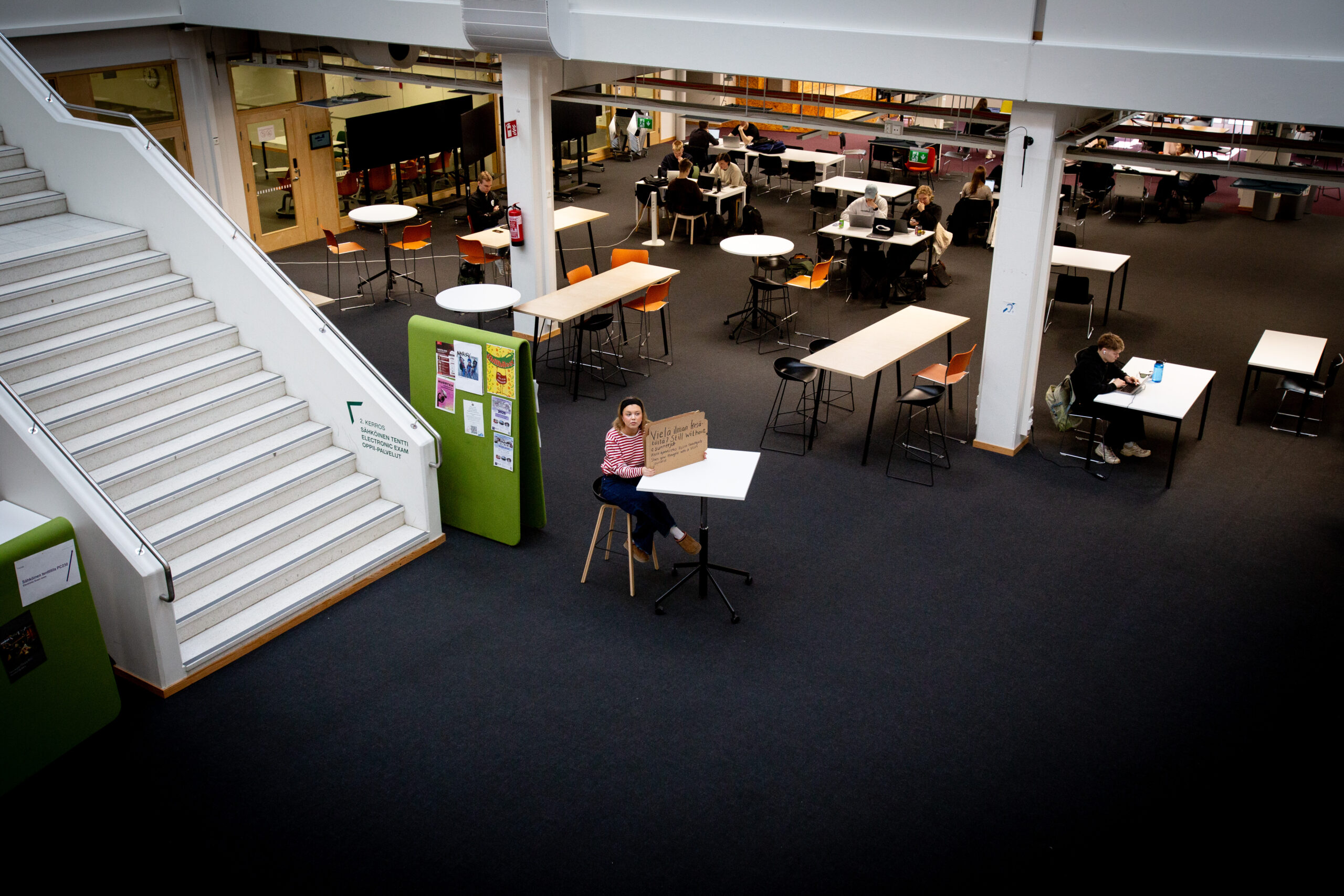
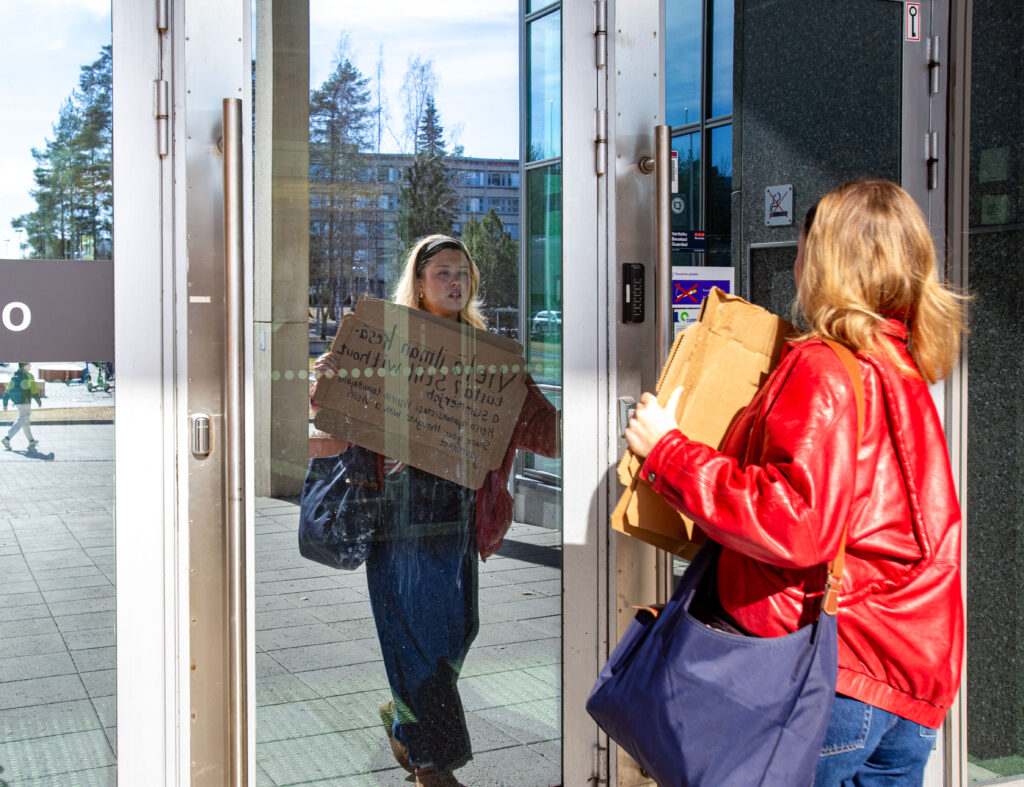
I feel a little embarrassed. I’m sitting in the lower lobby of the main building on the Hervanta campus, holding a cardboard sign. The text on the sign addresses an issue that students seem to be keeping quiet about.
”Still without a summer job? Share your thoughts with Visiiri”, both in Finnish and in English.
For two weeks now, I’ve been searching for a student who hasn’t found a summer job and would be willing to talk about their financial situation this summer. My attempts to reach someone have fallen on deaf ears, even though I’ve tried almost every possible way to get in touch with possible interviewees.
In the end, I decide to approach students face-to-face. Naturally, I find my way to campus.
Many of the students walking past me may still be without a summer job. The employment situation has deteriorated, and the summer job situation is exceptionally difficult this year:there are fewer vacancies than before, and a record number of applicants. According to Aamulehti, 21,000 people applied for Puuilo’s summer jobs alone—and only 400 of them got the job.
According to Kela, approximately 23,800 students received social assistance for at least one month from June to August in 2025. This summer, the financial situation of students is particularly difficult due to the housing allowance reform. The current housing supplement is tied to the months one receives student financial aid, and if a student does not complete any studies during the summer, the financial aid will be discontinued for the summer months.
The global situation is growing more tense, prices are rising, social benefits are being cut, and the headlines are filled with reports of crises. According to the recent Youth Barometer, young people’s satisfaction with their own lives has fallen to a historically low level.
And in the midst of all this, students repeatedly receive a message in their email:
Unfortunately, we have decided to move forward with other candidates at this time.
People tend to keep quiet about money
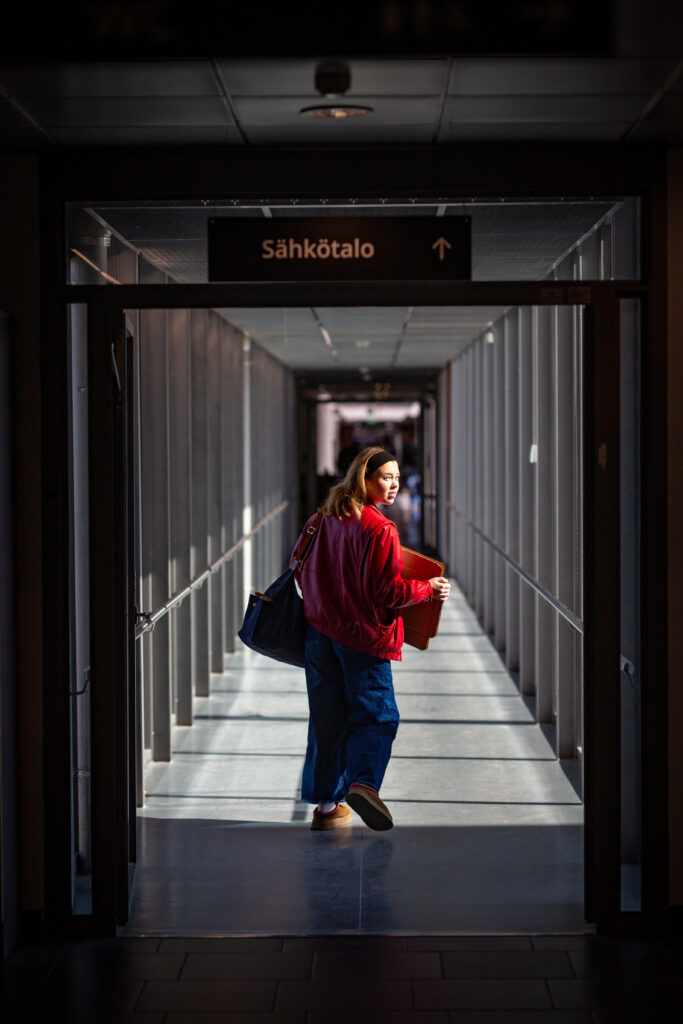
I let the sign do the speaking for me. I don’t want to disturb the students or intrude on their conversations. At this point, I’m still holding out hope that I will be able to lure some unemployed students over with the cardboard sign I got from a salesperson at Sale.
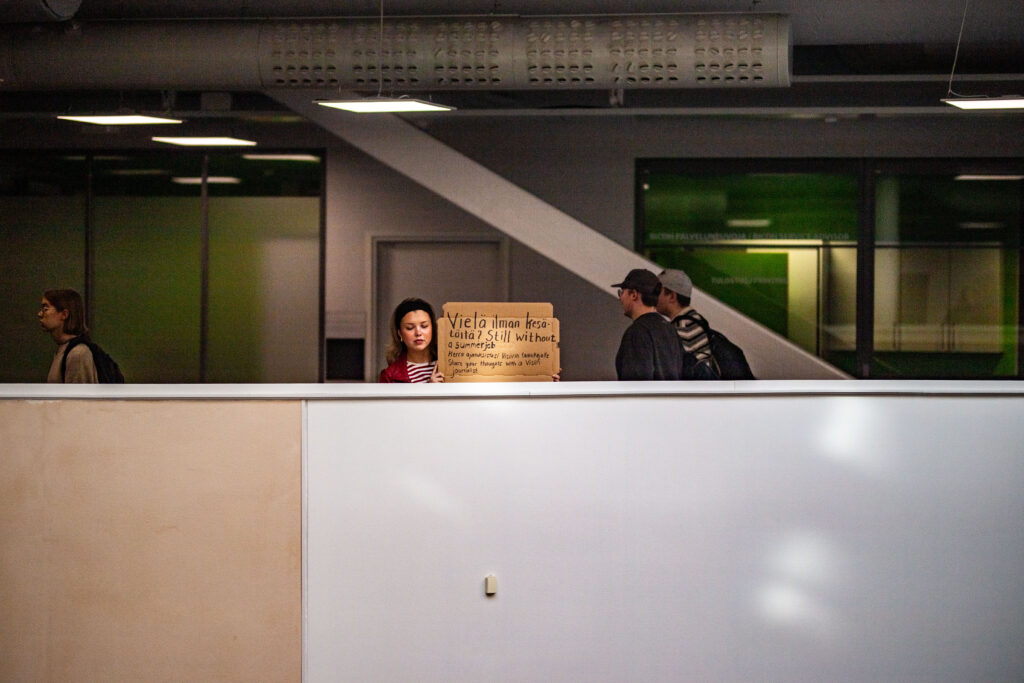
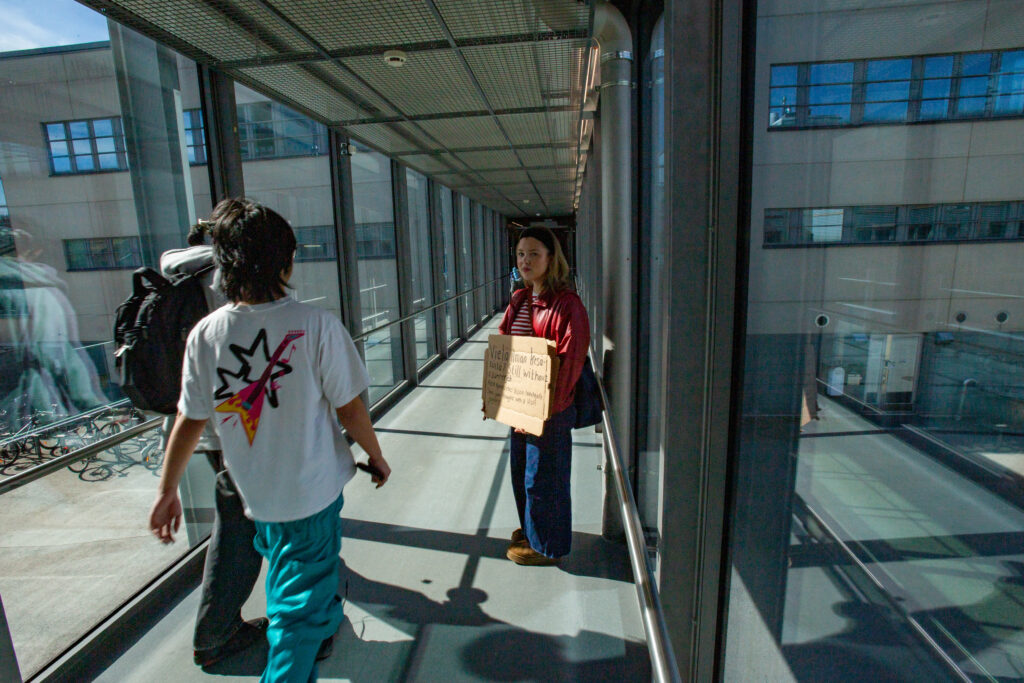
As I stand on campus, the surrounding hustle and bustle emphasizes the fact that no one really wants to talk to me. Many people glance at the sign as they pass by. Some are amused by it; others whisper about it to their friend. Some stop to read the sign but then continue their way. Mostly people just walk by.
While standing around with a sign and my empty inboxes frustrate me, as a student I understand well why people might not want to talk. Money is often kept quiet in Finland, especially when there is a lack of it. One might feel ashamed of their situation and fear being labelled as a bad job seeker. In public debate, students have repeatedly been portrayed as a burden to society—as a group that does not do enough or that lives off of other people’s money.
Perhaps students do not want to give up hope yet. It is April after all, and there is still a little over a month left until summer and the pause in Kela’s benefits.
Money is often kept quiet in Finland, especially when there is a lack of it.
The situation sucks
Ilona Taubert, TREY’s Specialist in Social Affairs, gives a frank assessment of the situation facing students next summer.

”The situation truly sucks.”
According to Taubert, the key problem is the structure of the system. The removal of students from the general housing allowance has weakened their livelihoods, which gets especially emphasized during the summer. The housing supplement gets paid only for the months a student withdraws the student financial aid, so without summer studies, there is no financial aid and therefore no housing supplement.
At the same time, the poor employment situation further complicates the situation.
”There are simply too few jobs at the moment. There are a large number of applicants from variety of backgrounds competing for the same positions. Students are part of this group”, Taubert says.
Not finding a summer job not only affects the summer, but the consequences stretch further into the future.
”If a student doesn’t get a job in the summer, they won’t be able to secure their livelihood for the rest of the year.”
Students often rely on the student loan during the summer, which worries Taubert. They do not enter working life on the same footing.
”Some have the financial security of their families to support them, while others have to finance their living with a loan. This will later manifest as wealth disparities.”
Unemployment during the summer increases uncertainty and pressure.
”Studying should not be a financial risk. If it becomes that, it’s a sign that something has gone wrong.”
Do you have a summer job?
Soon it becomes apparent that hanging out with a piece of cardboard is not going to get the job done. I’ve been walking around Tietotalo, Kampusareena, and the main building for almost an hour now.
I ask Ilona for help. She directs us to TREY’s office, where two board members agree to take me and the photographer to the guild rooms in the basement.
There I would find students without summer jobs.
I get excited that I will finally get to speak with someone. At the same time, the whole thing feels backwards: it means that many engineering and technology students are also without employment.
We arrive at the guild rooms.
”Hi, do you all have summer jobs?” I ask in English.
”Onko teillä kesätöitä?” I shout in Finnish.
Finally, I strike gold. At Bioner’s guild room, I get the answer I have been looking for. I explain how I have tried to find interviewees.
In response, I get cautious laughter from the students.
One of them agrees to be interviewed.
Thirty applications are not enough
The student introduces himself as Valtteri Väistö, a second-year student of biotechnology and biomedical engineering. He talks openly about how it feels when you can’t find a summer job.

”I have applied for more than thirty summer jobs this spring. I think I’ve been well qualified for all of them, but I haven’t been able to get one interview.”
The message “Unfortunately, we have decided to move forward with other candidates at this time” is starting to feel all too familiar.
Väistö recalls that in 2023, three applications were enough to land a job.
”Now thirty gets you nothing.”
He has applied for both customer service jobs and positions in his own field, for example, at Tampereen Vesi and Tampereen Energia, as well as positions in Joensuu. The situation is frustrating.
”There is something wrong in the system. There simply are no jobs, and we have to fight with recent graduates for the few positions available. The government has betrayed students.”
Väistö says that the uncertainty provokes self-criticism.
”Sometimes I wonder if I’ve failed.”
On the other hand, he knows that he is not alone in this. Many of his friends are in the same situation.
In the summer, Väistö plans to study and, if necessary, take out more loan if his savings or the spring’s share of the student loan are not enough. However, the summer courses available are starting to run low as this is the second summer he is studying with the student financial aid. The limitation in the aid months is a concern as well.
”I know that I will survive this summer. But if I don’t land a job next year, I really start to worry. Then there is just no money left.”
In 2023, three applications were enough. Now thirty gets you nothing.
Shame prevents people from speaking up
I return from the guild rooms up to the main building.
Walking around the campus makes me wonder why no one stopped to speak with me. The reason is understandable: few Finns voluntarily talk to strangers, and my approach was perhaps not the easiest one.
I got one student to speak, and I count that as a win.
Still, the silence stays with me. Shame and silence can be seen in the fact that no one stops to discuss these matters. Of course, no one has an obligation to talk about their situation—and perhaps no one wants to. Money is not the easiest subject to bring up.
I worry most of all about students who cannot afford to get into debt. According to Ilona Taubert, students graduating to low-wage fields, such as early childhood education teachers, class teachers, and translators, are in the most difficult position from the system’s point of view. For them, taking out a student loan is not a straightforward solution. However, without it, it may be difficult to cover everyday expenses during studies.
Writing this article also reminds me of my own situation a few summers ago. Back then, as a student, I did not have a summer job, but I got through the summer by relying on my studies, occasional gigs, and my savings. I also received student financial aid and general housing allowance, so the situation was still manageable for me.
Now, for many people, even these options are not available in the same way.
I pile up the cardboard and stuff it into the recycling bin.
Perhaps someone felt a moment of relief when they saw the sign finally ending up in the trash.
Social assistance is the last option
Johanna Juntunen, Kela’s Expert in Social Assistance, explains how the system works for students in the summer if they do not get employed.
”A student can register as an unemployed jobseeker, but they are not usually entitled to the unemployment benefit. They are considered a full-time student”, Juntunen says.
In practice, students can receive student financial aid and take out student loan within the limits of the aid months during the summer. If neither of these is possible, the student can receive social assistance. To qualify for it, the student must first have taken out and used all the available student loan. The student must also have investigated the possibilities of studying during the summer to receive student financial aid and have actively applied for a job. Social assistance is, in a way, the last option.
In 2025, students were transferred from the general housing allowance to the student housing supplement, which has effects on the summertime.
”The housing supplement is not paid for months in which a student does not receive student financial aid, and in such cases, they cannot receive general housing allowance, regardless of whether the rent is due,” says Juntunen.
According to Juntunen, the number of students applying for income support increases during the summer. Some try to get by on their savings or by taking out student loan.
A comprehensive reform of student financial aid is currently being prepared and is expected to take effect in August 2027. However, based on current information, it will not improve students’ financial situation during the summer.